Graduate Research at UC Berkeley
- Brandon Lou
- Oct 6, 2025
- 3 min read

Updated: Oct 24, 2025
After taking a class in additive manufacturing (AM) and seeing some of the cool work done at JPL with it, I fell in love with the limitless possibilities that came with AM either through part design or resin development. At this point, I was considering heading into the workforce after undergrad or go into graduate school, but the possibility of working on advanced systems and new technologies was the path I wanted my career to head in. After some discussions with graduate students and some working professionals, I decided that I wanted to be apart of the action and pursue my Masters degree in Professor Rayne Zheng's lab working with a PhD student on 3D printed piezoelectric actuators. Over the course of a year, this experience evolved into a full-fledged engineering effort. From material formulation to hardware design, culminating in the development of a prototype multi-material DLP 3D printer, and a sustainable conductive resin system.

We began by designing and printing piezoelectric actuators with the intent of creating a package that would be able to feature large deflections in a small form factor built from architectured piezoelectric components. The resin was made using a composite mixture of piezoelectric filler and essential monomers and photoinitiators. To optimize the piezoelectric effect of the printed components, I tested various resin compositions and printing parameters to maximize the loading of piezoelectric filler, while maintaining printability.
During these experiments, I worked extensively in CAD, designing intricate lattice and multilayered geometries to optimize actuation and sensing behavior. The small form factor and multifunctional requirements of the device inspired a shift toward multi-material printing, integrating both active and conductive materials in a single build. This required developing an alternative conductive resin that was not only electrically functional but also chemically compatible with the piezoelectric resin during post-processing. A challenge that involved balancing viscosity, curing kinetics, and filler dispersion.




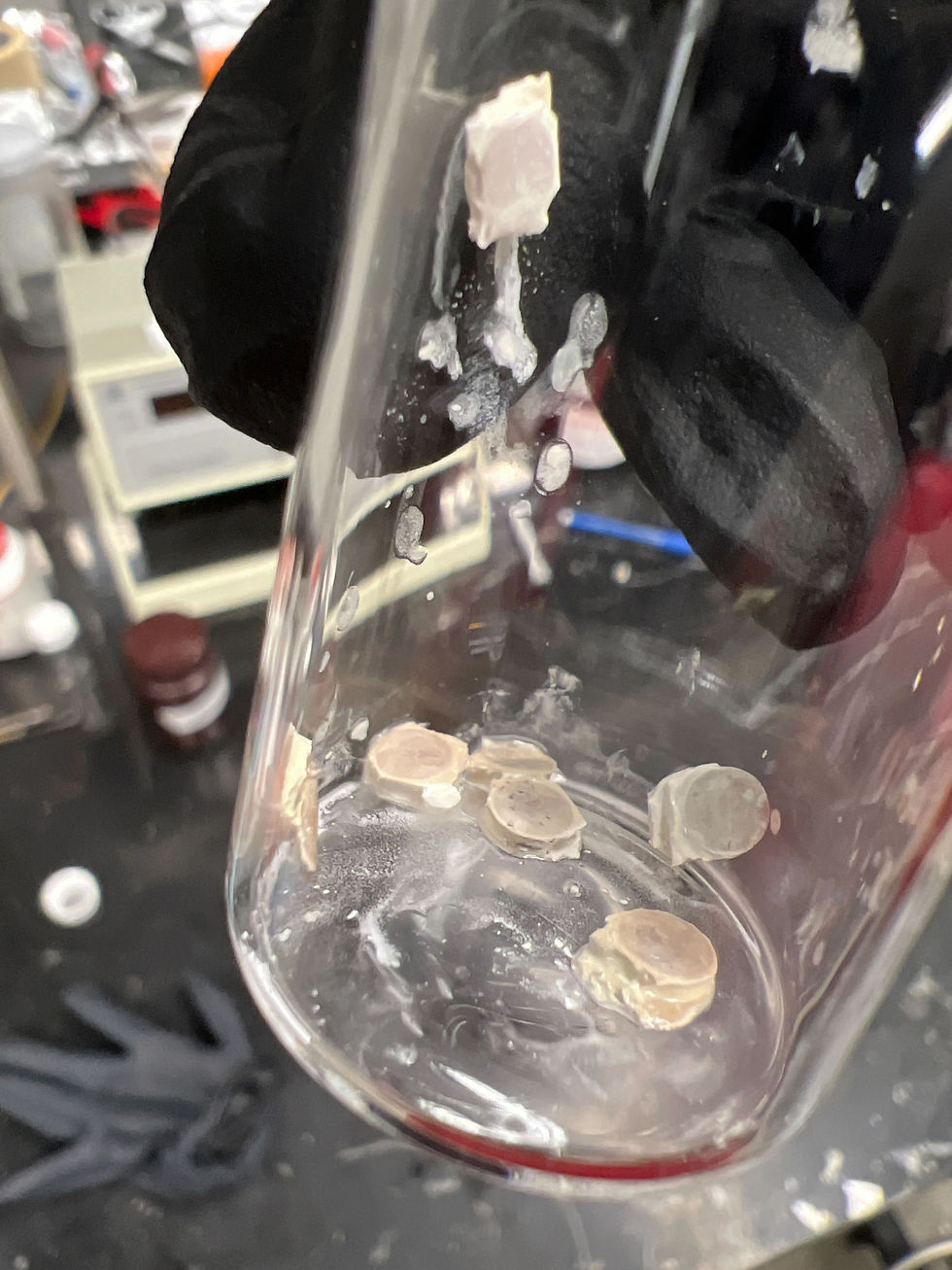
ITO Composite Resin; After ball milling, the ITO filler may have initiated polymerization without UV light making this filler unsuitable.
To bring these ideas to life, I engineered and built a custom multi-material DLP 3D printer from the ground up, designed specifically to handle high viscosity, high loading resins that traditional printers struggle with. The system featured a heated vat and precision blade recoater that enabled smooth deposition and leveling of thick, particle rich resins. To facilitate multi-material printing, we implemented an automated washing system capable of efficiently switching between resins, even those too viscous for conventional solvent cleaning. This system combined ultrasonic transducers to dislodge residual resin from the printed part and centrifugal force to remove excess solution, ensuring clean transitions between functional materials.
For large area printing, we designed an optical projection system using image stitching to expand the print area without compromising curing power or resolution. By using a tested UV projection module with sufficient power intensity, we maintained high energy density necessary to cure the lab’s most commonly used photopolymers while achieving scalable print sizes (9x larger area). Together, these features allowed the printer to seamlessly fabricate components that integrated active piezoelectric, conductive, and structural resins in a single build. The printer became a testbed for fabricating next-generation smart structures and piezoelectric devices, demonstrating the feasibility of additive manufacturing for integrated electromechanical systems.

Through this project, I learned that innovation in AM doesn’t just happen through new designs, it happens when materials and processes converge. From optimizing resin formulations to designing hardware that could bring those materials to life, I developed a deep appreciation for the intersection of material science, robotic assembly, and system engineering.
TL;DR
In short, I ...
Developed and fabricated multi material piezoelectric actuators using a custom built direct light processing (DLP) 3D printer
Optimized resin formulations and printing parameters for various materials including piezoelectric and conductive fillers
Researched sustainable alternatives for resin fillers that had to be compatible with the extreme post processing requirements of the piezoelectric material
Deigned and built a multi material DLP 3D printer capable of printing active, conductive, and structural materials with high volumetric loading (viscous resins)


Comments